On BNPL
Regulate now or pay later


Americans are no strangers to debt. Consumers collectively hold more than 1 trillion dollars in credit card debt and over 1.5 trillion dollars in student loan debt.1
Amid the COVID-19 pandemic, a mix of rising inflation, government stimulus checks, and a boom in online shopping drove “Buy Now Pay Later” (BNPL) providers into the American consumer’s consciousness full-time, with the number of BNPL loans originating in the United States growing by 970% from 2019 to 2021.2
Klarna is a prime example. Their $15.1B Wall Street IPO cements them as a leader in this space and a legitimate part of the global economy.3 BNPL appears here to stay, with the most popular payment plan splitting the price of a purchase into 4 interest free installments spread out over the next 6 weeks. (For the rest of this article, we’ll use BNPL and Pay-in-4 interchangeably). BNPL is most common in online checkouts, however brick and mortar establishments have been steadily adopting this payment option.4
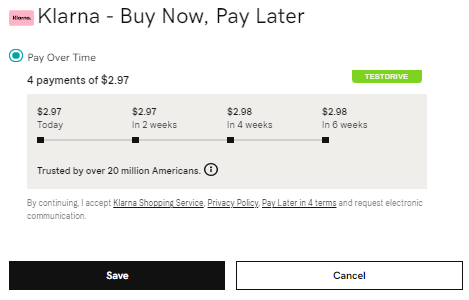
So how do BNPL providers make money when they issue loans at 0% interest and take on all the risk, with merchants bearing no liability? The primary source of revenue for these companies is a transaction fee that is charged to merchants. This fee typically ranges from 2-8% of the sale cost, which is higher than the 1.5-3.5% cut that credit card companies take.5 These providers also usually make money from late fees that are charged to consumers for missed payments.
BNPL companies often purport that they are a safer form of credit than credit cards and hence are better for consumers. In fact, Klarna’s F-1 makes many such claims, focusing on credit card debt held by American consumers and the impacts of high interest rates on their financial health.6 When scaled down to the level of a singular purchase, this initially appears to be true and interest free loans technically grant more flexibility for financially savvy consumers.

BNPL is typically used for small dollar spending (at least when starting out) whereas a revolving line of credit can be used for relatively large purchases for which the consumer may struggle to make payments on in a timely manner.7 Additionally, the 0% APR on Pay-in-4 loans means that the risk of ending up in unmanageable debt from missed payments is seemingly low compared to credit cards which often charge exorbitant interest rates. This appears true even when accounting for the late fees that BNPL companies charge for late payments.
However, when taking a bird’s eye view of the entire credit ecosystem, the harmful effects of BNPL on consumers becomes more apparent. Momentarily ignoring late fees and other charges of that nature, BNPL may seem completely safe in that the offered loans carry a 0% interest rate. But the inherent danger of Pay-in-4 lies in its risk of overextending consumers. This is by design.
One study which examined the behaviors of 300,000 shoppers found that consumers who used BNPL had their purchase likelihood increase from 17% to 26%, along with a 10% increase in basket size.8 Alarmingly, this increased propensity to buy lasted for close to 6 months, indicating a more than short-term effect.9 This can be explained by the symbolic numerosity effect which causes consumers to perceive installment payments as less expensive than a single payment of total price (e.g. 4 payments of $25 vs one payment of $100).10
This also explains why merchants are happy to pay a relatively higher fee compared to the one credit card companies charge, as BNPL providers promise increased sales, larger average order values, reduced cart abandonment, and enhanced customer acquisition.
Combined with the observation that BNPL borrowers tend to have both higher rates of unsecured consumer debt than the general population and that borrowers with subprime or deep subprime credit scores make up over half of BNPL originations, significant financial strain on consumers is a probable and worrying consequence.11
This risk is compounded by the lack of transparency within the BNPL industry. While some companies like Affirm are sharing consumer data with credit bureaus, other major players in the BNPL space have not yet done so.12 This enables practices like loan-stacking where borrowers not only have multiple, simultaneous BNPL loans, but are also borrowing across multiple BNPL providers. The lack of visibility between firms limits the effectiveness of any employed underwriting standards and creates chances for financial overextension. In a survey of the industry released in January 2025, the CFPB found that 62.7% of BNPL borrowers had simultaneous, active loans and 32.6% of borrowers had those loans across at least 2 providers in 2022.13
While BNPL providers may point to lower default rates on their Pay-in-4 products compared to credit cards, this statistic may be misleading. For one, customers may be paying off their BNPL loans at the expense of carrying a larger balance elsewhere. One Bloomberg survey found that 28% of consumers who owed money to BNPL services were delinquent on other debt because of BNPL spending.14 Furthermore, BNPL companies often enable automatic repayment at purchase time, meaning that the risk of being charged an overdraft or NSF (non-sufficient funds) fee increases for consumers if they do not have enough money in their account to make the installment payment.15 In theory, this practice allows for low default rates, while increasing the overall debt burden of a consumer. In fact, a consumer survey of BNPL users in California found that 37% had an overdraft fee in the last 6 months.16
While it is already the case that BNPL products are placing financial strain on consumers, the risks appear to only be growing. Taking a look at Klarna’s F-1 filing, Klarna had consumer credit losses of 495 million in 2024 (an increase from 353 million in the year prior) and while it claims to have turned a profit, careful examination reveals that the losses were only offset by the sale of part of its business.17 Consumer credit losses have also grown by 17% in the first quarter of 2025 compared to a year earlier.18 Additionally, the share of revenue from late fees and interest (as part of its financing products) have steadily been increasing over the years, even as Klarna claims to be a consumer friendly alternative to credit cards. From 2022 to 2024, consumer service revenue (largely comprised of late fees) increased from 12% to 16% of transaction and service revenue.19
As BNPL providers like Klarna face increasing pressure to demonstrate profitability to shareholders, they may decide to change their business models in ways that are harmful to consumers, such as hiking late fees or reducing the quality of dispute resolution processes. There are also already growing shifts to interest-bearing loans with high APRs which may be especially dangerous for consumers if they are unable to clearly distinguish these products from the heavily marketed Pay-in-4 product.20 Providers have already candidly shared that Pay-in-4 is simply an on ramp to these higher margin products.21
Despite the increasing concerns surrounding consumer financial health and BNPL use, regulations in the U.S. have been fairly limited and slow to adapt to changes by providers. In May 2024, the CFPB issued an interpretive rule, which brought BNPL under the purview of certain parts of Regulation Z, labeling it a credit card.22 This placed certain requirements on providers regarding disclosures, handling of billing disputes, advertising, and more. However, with the takeover of the CFPB by the new administration, the interpretive rule was rescinded in May of 2025.23
In the absence of federal legislation, some states have taken it upon themselves to regulate BNPL products, typically through application of existing laws. California for example requires BNPL providers to have state lending licenses and abide by state lending requirements.24 These state laws typically regulate aspects of lending such as junk fees, excess finance charges, payment schedules, and late charges. However, not all states are interested in regulating the BNPL industry and even when they are, their approaches may vary drastically. Patchwork regulation and regulatory uncertainty caused by administration turnover both hurts consumers and increases the cost of compliance by providers.
It is vital that the CFPB moves decisively to address both the ongoing and potential harms by BNPL products. At minimum, the CFPB should create regulations to make payment schedules for BNPL loans predictable for consumers, enforce detailed disclosures of any and all fees, mandate that automatic payments be opt-in, work with credit bureaus to create standardized forms of reporting for BNPL loans, and require a much more rigorous ability-to-pay analysis prior to lending.25 Failure to do so risks entrenching and extending lending practices that disproportionately harm financially vulnerable consumers.
Ultimately, the future of both this rapidly growing industry and the consumers it serves will depend on whether regulators are empowered and rise to the challenge.
Center for Microeconomic Data, Federal Reserve Bank of New York. “QUARTERLY REPORT ON HOUSEHOLD DEBT AND CREDIT.” New York: New York, 2025. https://www.newyorkfed.org/microeconomics/hhdc/background.html
Consumer Financial Protection Bureau. “Buy Now, Pay Later: Market trends and consumer impacts” Consumer Financial Protection Bureau, September 2022. https://files.consumerfinance.gov/f/documents/cfpb_buy-now-pay-later-market-trends-consumer-impacts_report_2022-09.pdf
Kaur, Pam. “Klarna’s IPO Breaks the Fintech Drought at a $15 Billion Valuation.” Forbes, September 18, 2025. https://www.forbes.com/sites/pamkaur/2025/09/18/klarnas-ipo-breaks-the-fintech-drought-at-a-15-billion-valuation/.
Hall, Liliana. “Buy Now, Pay Later Is Pushing Its Way into Everyday Shopping with Physical Cards.” Money, June 11, 2025. https://money.com/bnpl-physical-cards-everyday-shopping/.
Mameli, Enrica. “How Does Buy Now Pay Later (BNPL) Work for Merchants?” Checkout.com, April 1, 2025. https://www.checkout.com/blog/how-does-buy-now-pay-later-bnpl-work-for-merchants.; Johnson, Holly D. “Average Cost of Credit Card Processing Fees.” Bankrate, July 14, 2025. https://www.bankrate.com/credit-cards/business/merchants-guide-to-credit-card-processing-fees/.
Klarna Group plc. “FORM F-1 REGISTRATION STATEMENT UNDER THE SECURITIES ACT OF 1933 Klarna Group Plc.” SEC, March 14, 2025. https://www.sec.gov/Archives/edgar/data/2003292/000162828025012824/klarnagroupplcf-1.htm. [Klarna F-1] An F-1 form is the registration required for foreign companies prior to being listed on a U.S. Stock Exchange. Klarna filed its F-1 on March 14, 2025 and IPO’d on September 10, 2025.
Figure 1. Consumer Financial Protection Bureau. “Consumer Use of Buy Now, Pay Later and Other Unsecured Debt.” Consumer Financial Protection Bureau, January 2025. https://files.consumerfinance.gov/f/documents/cfpb_BNPL_Report_2025_01.pdf. [CFPB]
Ang, Dionysius, and Stijn Maesen. “Research: How ‘Buy Now, Pay Later’ Is Changing Consumer Spending.” Harvard Business Review, November 26, 2024. https://hbr.org/2024/11/research-how-buy-now-pay-later-is-changing-consumer-spending.
Ibid.
Ashby, Rhys, Shahin Sharifi, Jun Yao, and Lawrence Ang. “The Influence of the Buy-Now-Pay-Later Payment Mode on Consumer Spending Decisions.” Journal of Retailing 101, no. 1 (April 2025): 103–19. https://doi.org/10.1016/j.jretai.2025.01.003.
CFPB, supra note 2, Tables 3 & 9
Cooley, Patrick. “Affirm, Other BNPL Players Ratchet up Credit Bureau Reporting.” Payments Dive, March 24, 2025. https://www.paymentsdive.com/news/affirm-other-bnpl-players-ratchet-up-credit-bureau-reporting/743287/.
CFPB, supra note 2, Table 4
Cachero, Paulina, and Paige Smith. “Americans Are Racking Up ‘Phantom Debt’ That Wall Street Can’t Track.” Bloomberg, May 7, 2024. https://www.bloomberg.com/news/articles/2024-05-07/-buy-now-pay-later-has-americans-racking-up-phantom-debt.
CFPB, supra note 2, Page 3
Gittleman, Rachel, Lucia Mattox, and Peter Smith. “Issue Brief: Consumer Understanding of Buy Now, Pay Later in California .” Center for Responsible Lending, October 2023. https://www.responsiblelending.org/sites/default/files/nodes/files/research-publication/crl-cfa-bnpl-issuebrief-oct2023.pdf. It is important to note that this observation is not causal. It could be the case for example that consumers of BNPL are relatively worse off financially, making them more likely to have incurred overdraft fees independent of their usage of BNPL products.
Klarna F-1, supra note 1
McCorvey, J.J. “Buy Now, Pay Never? Some Klarna Users Struggle to Repay Loans as U.S. Consumer Debt Rises.” NBC News, May 20, 2025. https://www.nbcnews.com/business/personal-finance/buy-now-pay-never-klarna-users-struggle-repay-loans-us-consumer-debt-s-rcna207940.
Klarna F-1, supra note 1
Klarna Group plc. “The Flexible Way to Pay at Walmart with OnePay Later.” Klarna, March 2025. https://www.klarna.com/us/klarna-onepay/.
Ledbetter, James. “‘Buy Now, Pay Later’ Is the Victim of Its Own Success.” The New York Times, January 28, 2023. https://www.nytimes.com/2023/01/28/business/dealbook/buy-now-pay-later-struggles.html.
Consumer Financial Protection Bureau. “CFPB Takes Action to Ensure Consumers Can Dispute Charges and Obtain Refunds on Buy Now, Pay Later Loans.” Consumer Financial Protection Bureau, May 22, 2024. https://www.consumerfinance.gov/about-us/newsroom/cfpb-takes-action-to-ensure-consumers-can-dispute-charges-and-obtain-refunds-on-buy-now-pay-later-loans/.
National Consumer Law Center. “Continued Vitality of 67 Withdrawn CFPB Guidance Documents.” NCLC Digital Library, May 13, 2025. https://library.nclc.org/article/continued-vitality-67-withdrawn-cfpb-guidance-documents. Arguably, the logic issued in the interpretive rule is still sound and so the analysis within should still hold weight for courts.
Department of Financial Protection & Innovation. “Buy Now, Pay Later: Protect Yourself Before You Check Out.” Department of Financial Protection & Innovation. Accessed September 25, 2025. https://dfpi.ca.gov/news/insights/buy-now-pay-later-protect-yourself-before-you-check-out/.
Johnson, Morgan .“Regulate Now or Pay Later: A Late Start on Regulating the BNPL Industry Endangers Consumers”, 27 N.C. BANKING INST. 454 (2023): 480-490. https://scholarship.law.unc.edu/cgi/viewcontent.cgi?article=1574&context=ncbi